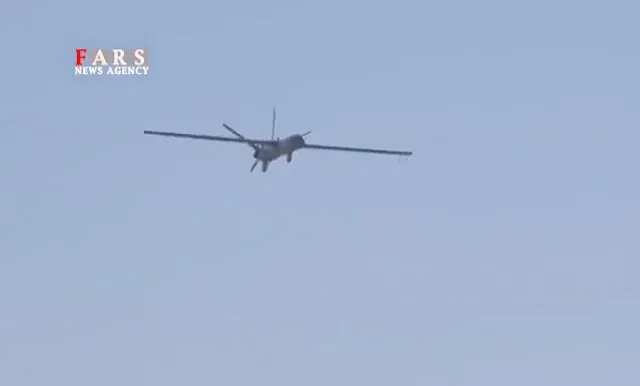
Also known as: Samad-1, Samad-2, Samad-3, Samad-4, UAV-X (UN Panel designation for Samad-2)
The Houthi Samad family includes reconnaissance and one-way attack variants. A 2020 academic analysis estimates performance with explicit model uncertainty; Wilson Center’s later overview reports different variant limits. Calculations and reported capabilities are kept separate from demonstrated flights.[1][2]
Top-view bounding dimensions share one metre scale. Internal contours and side profiles are schematic; height is not inferred. Ranges show their largest outline and retain their labels.
Public-source profile. Performance claims are attributed; type links do not verify an incident identification.
The numbers, with their sources
Intervals preserve the published bounds; they are not statistical confidence intervals. A blank lower or upper bound stays open. Values belong to the named configuration, not every aircraft.
Unless a row says otherwise: 2020 · Analysis source
Body length
2.8 m[1]Samad-2 · 2020 study · UN-derived dimensions Reported figure; no independent test
Wingspan
4.5 m[1]Samad-2 · 2020 study · UN-derived dimensions Reported figure; no independent test
Liutyi (An-196)Liutyi · early programme reported in 2024 · Published flight range · 2024 · Reported figure; no independent test> 1000 km Ukrainska Pravda
Bober / Beaver (UJ-26)Bober · Espreso reported specification table, not measured by DroneLedger · Published flight range · Publication date not stated · Reported figure; no independent test1000 km Espreso
Molniya fixed-wing FPV familyMolniya-1 · CSIS 2026 baseline strike configuration · Published flight range · 2026 · Approximate / analyst compilation30–40 km CSIS
Molniya fixed-wing FPV familyMolniya-2 · CSIS 2026 twin-engine configuration · Published flight range · 2026 · Published upper limit≤ 80 km CSIS
AQ-400 ScytheAQ-400 Scythe · December 2023 configuration, TWZ reporting · published lower bound on claimed maximum range · Published flight range · 2023 · Published lower limit≥ 750 km The War Zone
Arash-2Arash-2 · Iran Watch table · Published flight range · Publication date not stated · Reported figure; no independent test1000 km Wisconsin Project / Iran Watch
Arash-2Arash-2 · Iranian maximum-range claim in Iran Watch footnote 19 · Published flight range · Publication date not stated · Published upper limit≤ 2000 km Wisconsin Project / Iran Watch
Geran-4Geran-4 · GUR baseline catalogue, not the separate October 2026 modification · Published flight range · 2026 · Reported figure; no independent test770 km Defence Intelligence of Ukraine
Italmas (Izdeliye-54)Italmas · ZALA AERO 2023 statement (“exceeding 200 kilometres”) · Published flight range · 2023 · Published lower limit> 200 km ZALA AERO
SpektreWorks LUCASFLM 136 (SpektreWorks target-drone variant) · via The Aviationist 2025 · 350 nmi · Published flight range · 2025 · Manufacturer claimNot publicly established The Aviationist
Samad names a Houthi drone family, not one aircraft specification. The cited study describes Samad-1 reconnaissance and Samad-2/-3 attack variants; these sources do not establish one manufacturer for every model. Voskuijl, Dekkers & Savelsberg / Science & Global Security · Wilson Center
The 2020 study’s 2.8 m length and 4.5 m wingspan refer to Samad-2, not all Samad drones. Its range calculations are model outputs, not demonstrated flights; Wilson’s later reported limits are a different evidence class. Do not transfer Samad-3 range to Samad-1 or -2. Voskuijl, Dekkers & Savelsberg / Science & Global Security · Wilson Center
In our selective archive: 1 dossier · 1 Model named / assessed · 0 Family-level link · model not established. Dossier links record what sources report, not independent model identification.
DroneLedger editorial team, publisher and editor responsible for this project.
AI-assisted reading of public sources; figures and quotations are tied to the cited research edition. No independent aircraft examination or personal review is claimed. Method and corrections
also known as Samad-1, Samad-2, Samad-3, Samad-4, UAV-X (UN Panel designation for Samad-2)
Public-source profile. Performance claims are attributed; type links do not verify an incident identification.
No cookies, tracking or scripts. Reader browsers request this card from DroneLedger; standard server logs may record requests. This card updates with the next site release; reload to see changes.
Warhead mass: ≤ 18 kg · Samad-3 · Wilson 2024 reported upper limit · Published upper limit.Wilson Center
DRONELEDGER / SCALE LAB
Turn the scale plane
A flat, schematic outline in perspective, not a 3D model. Only sourced length and span are scaled; height and internal geometry are unknown. For intervals, the upper endpoints are drawn.
Human · illustrative 1.8 m · Samad-2 · 2020 study · UN-derived dimensions
Samad-1 / Samad-2 / Samad-3 (Houthi) · Samad-2 · 2020 study · UN-derived dimensions · Body length[1] · Wingspan[1]
Human height is an illustrative 1.8 m; bus length an illustrative 12 m. Car length uses the cited MINI specification. Vehicle heights and drone side contours are schematic. Top views preserve published length and span; an absent dimension is never guessed.
Dossiers, not aircraft or successful strikes. Counts reflect archive coverage and reporting choices. Dates below are dossier event dates; unknown months are excluded from the chart.
Linked dossiers use source-indexed type fields or positive editorial type assessments. These are not verified identifications. Free-text name mentions and unknown or negative assessments do not count.
1 Model named / assessed0 Family-level link · model not established
Family-level links are included separately in totals, timelines and maps. Shahed-family reports lead here through the Shahed-136 profile; unspecified jet-drone reports through Geran-3. Neither establishes that model, and generic “drone” reports remain excluded.
Dossiers per monthDossiers per month · Source notebook
≤ 1800 km[2]Samad-3 · Wilson 2024 reported upper limit · 2024 Published upper limit · Analysis source
Warhead mass
≤ 18 kg[2]Samad-3 · Wilson 2024 reported upper limit · 2024 Published upper limit · Analysis source
Form, sound & identification limits
The 887–989 km and 1,831–2,101 km intervals span medians from different analytical models. They are neither confidence intervals nor verified operating ranges. The study’s Samad-2 dimensions do not become dimensions for every Samad-1, -3 or -4.[1]
Samad-1 has a reconnaissance role in the study, while Samad-2 and -3 are discussed as attack aircraft. Wilson’s 2024 overview is separate analysis, not a replication of the 2020 simulation or an independent test of each number.[1][2]
Shape or sound alone cannot identify a drone. Follow local public-safety alerts; do not approach wreckage.
No licensed, model-attested recording is available in our sound library.
Short schematic animation, not to scale. Icons: ↔ reported range · dial: speed · weight: warhead or payload · clock: endurance · tag: published unit-cost estimate (third-party, with year) · factory: countries of origin. All figures are approximate (≈) and come from the sources below.
What does it cost?
Published USD figures use different price bases and years. Airframes, export packages and support are not equivalent. These are not current offers or verified production costs.
Unknown in reviewed sources
Countermeasures in public analysis
No type-specific, independently supported summary is included in this edition.
Dataset DOI for this exact version: Not yet in a DOI snapshot · DOI binding manifest
DroneLedger editorial team. Samad-1 / Samad-2 / Samad-3 (Houthi). ID samad-family; revision or edition 01 Nov 2026; published 01 Nov 2026. https://droneincidents.com/data/citations/type/samad-family/2026-11-01/97fe007bef33611e35acc3bfa4a4353e596f194ecc793bc0c6663d191d63dbf4/data.json Accessed 27 Nov 2026. SHA-256 97fe007bef33611e35acc3bfa4a4353e596f194ecc793bc0c6663d191d63dbf4 (https://droneincidents.com/data/citations/type/samad-family/2026-11-01/97fe007bef33611e35acc3bfa4a4353e596f194ecc793bc0c6663d191d63dbf4/data.json). Not yet in a DOI snapshot.
Citation uses the English reference edition. Access date is the UTC date when this page was built; change it to your consultation date when reusing the citation.