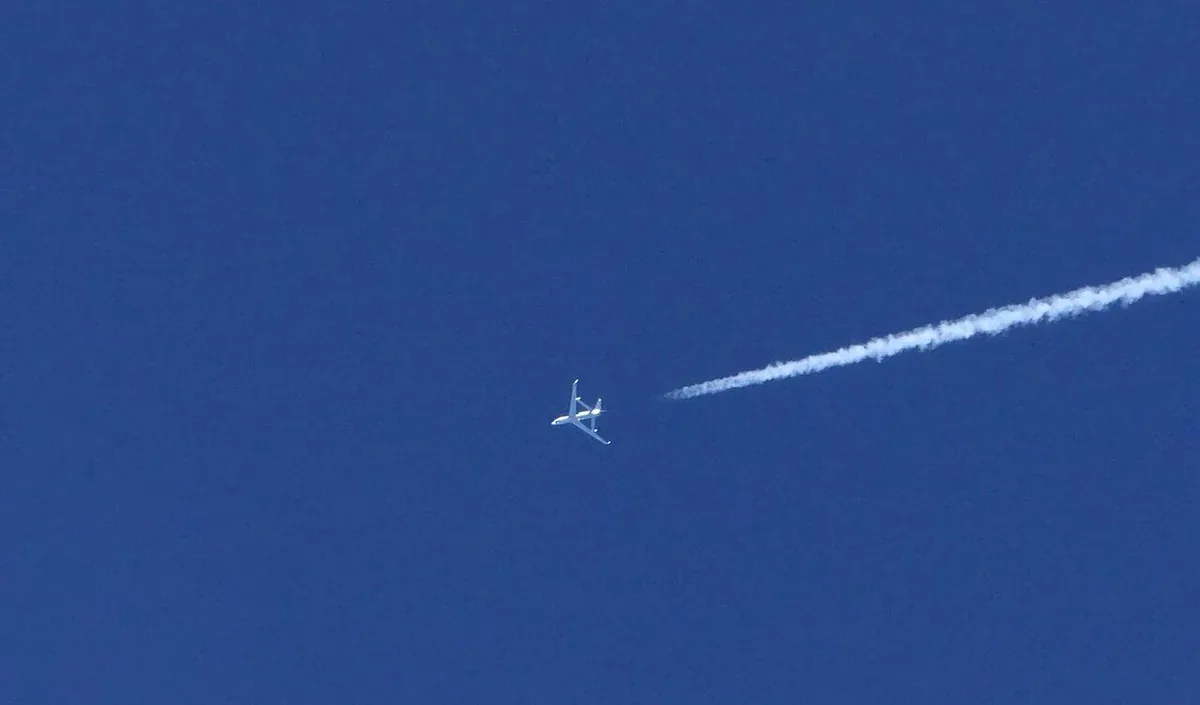
WZ-7 is a Chinese high-altitude reconnaissance drone with a joined-wing layout. China’s defence ministry records combat training. The Mitchell Institute supplies the dated public analytical figures used here. Those figures are not a manufacturer specification or an independent flight test.[1][2]
Aircraft identified as WZ-7 by Japan’s Ministry of Defense in its 30 July 2024 release.Japan Ministry of Defense / Japan Air Self Defense Force · CC BY 4.0 · via Wikimedia Commons · ResizedDiagram and size references
Sourced dimensions are listed; no scaled drawing is provided for this configuration.
Schematic top view of the general configuration. Not to scale and not an exact depiction of the model.
Public-source profile. Performance claims are attributed; type links do not verify an incident identification.
The numbers, with their sources
Intervals preserve the published bounds; they are not statistical confidence intervals. A blank lower or upper bound stays open. Values belong to the named configuration, not every aircraft.
Body length
≈ 14.300 m[1]WZ-7 · Mitchell Institute analytical listing · Publication year unknown · consulted 2026-11-08 Approximate / analyst compilation
Wingspan
≈ 24.900 m[1]WZ-7 · Mitchell Institute analytical listing · Publication year unknown · consulted 2026-11-08 Approximate / analyst compilation
Take-off mass
Not publicly established
Published speed · knots
≤ 405 kt[1]WZ-7 · Mitchell Institute analytical listing · Publication year unknown · consulted 2026-11-08 Published upper limit
Published flight range
≤ 7000.0 km[1]WZ-7 · Mitchell Institute analytical listing · Publication year unknown · consulted 2026-11-08 Published upper limit
Endurance
Not publicly established
Payload
Not publicly established
Engine / propulsion
One Guizhou WP-13, according to the Mitchell Institute.[1]WZ-7 · Mitchell Institute listing
Guidance / control link
Not publicly established
First flight / first reported use
Not publicly established
Manufacturer
Guizhou Aircraft Industry Corporation[1]WZ-7 · Mitchell Institute attribution
Operators
PLAAF and PLANAF, according to the Mitchell Institute.[1]WZ-7 · Mitchell Institute listing
Service status
Active, according to the Mitchell Institute. China’s ministry documents PLAAF training.[1]WZ-7 · public service record
Same-class research profiles · published range, km · open bounds remain open
No cookies, tracking or scripts. Reader browsers request this card from DroneLedger; standard server logs may record requests. This card updates with the next site release; reload to see changes.
No scaled drawing is provided for this configuration. See the sourced dimensions and their limitations.
No scaled drawing is provided for this configuration. See the sourced dimensions and their limitations.
No scaled drawing is provided for this configuration. See the sourced dimensions and their limitations.
WZ-7 Soaring Dragon · WZ-7 · Mitchell Institute analytical listing · Body length[1] · Wingspan[1]
Human height is an illustrative 1.8 m; bus length an illustrative 12 m. Car length uses the cited MINI specification. Vehicle heights and drone side contours are schematic. Top views preserve published length and span; an absent dimension is never guessed.
No sourced family relationship recorded in this edition. Similar roles do not establish a common design.
Form, sound & identification limits
The ministry’s report documents participation in training. It publishes no dimensions or performance figures. “high-altitude reconnaissance drone”[2]
Shape or sound alone cannot identify a drone. Follow local public-safety alerts; do not approach wreckage.
No licensed, model-attested recording is available in our sound library.
What does it cost?
Published USD figures use different price bases and years. Airframes, export packages and support are not equivalent. These are not current offers or verified production costs.
Unknown in reviewed sources
Countermeasures in public analysis
No type-specific, independently supported summary is included in this edition.